- Have any questions?
- 01725030045
- info@surgimart.in

Why OKX Spot Trading Feels Different — and How to Log In Without Losing Your Mind
Guide complet du casino en ligne : tout ce qu’il faut savoir avant de jouer
June 29, 2025Guide complet du casino en ligne : tout ce que vous devez savoir en 2024
July 1, 2025Okay, so check this out—I’ve been around a few exchanges, and OKX has this quiet confidence that bugs me in a good way. Wow! It doesn’t shout like some platforms; it just… works. My instinct said “solid backend,” but then I noticed a few UI quirks that threw me off at first. Seriously? Yep.
First impressions matter. When you land on OKX, the layout is straightforward, but there are layers—spot trading, margin, futures—each with its own little ecosystem. Initially I thought the learning curve would be steep, but actually, once you log in and fiddle for ten minutes, the pieces start to click. On one hand it’s intuitive; on the other hand, there are options tucked away that only reveal themselves if you look closely. Hmm…
Here’s the thing. If you’re a US-based trader used to rapid logins and single-click buys, OKX asks you to pause and confirm. That’s not a bad thing. It forces a slight discipline into trading. My gut reaction: safer. Then again, that extra step can frustrate during high-volatility moments. I’m biased, but I’d rather the extra check than a fat-finger loss—though I know some folks disagree.
Logging in to OKX: Practical Steps (and a few caveats)
Whoa! Alright—let’s get practical. You want to access your account, trade spot, move coins to the wallet, whatever. Start here: okx. Really, that’s the door. But a couple of tips before you click: use a secure network, have your 2FA ready, and don’t rush through verification screens.
Step-by-step—short and useful: create an account with a strong password, verify your email, set up 2FA (Google Authenticator or SMS, though I’m biased toward authenticator apps), and complete KYC if you plan to do fiat on-ramps. Then choose your spot wallet. Simple? Kind of. There are micro-decisions that matter: which verification level you need, and whether to enable withdrawal whitelists. My instinct said enable the whitelist immediately. Do it.
Something felt off about my first session—my session timed out unexpectedly. Actually, wait—let me rephrase that: I’d left a tab open overnight and came back to a logged-out page. Fine. Security wins. But make sure you keep recovery codes safe; losing access to 2FA is pain.
Spot Trading on OKX — A Trader’s View
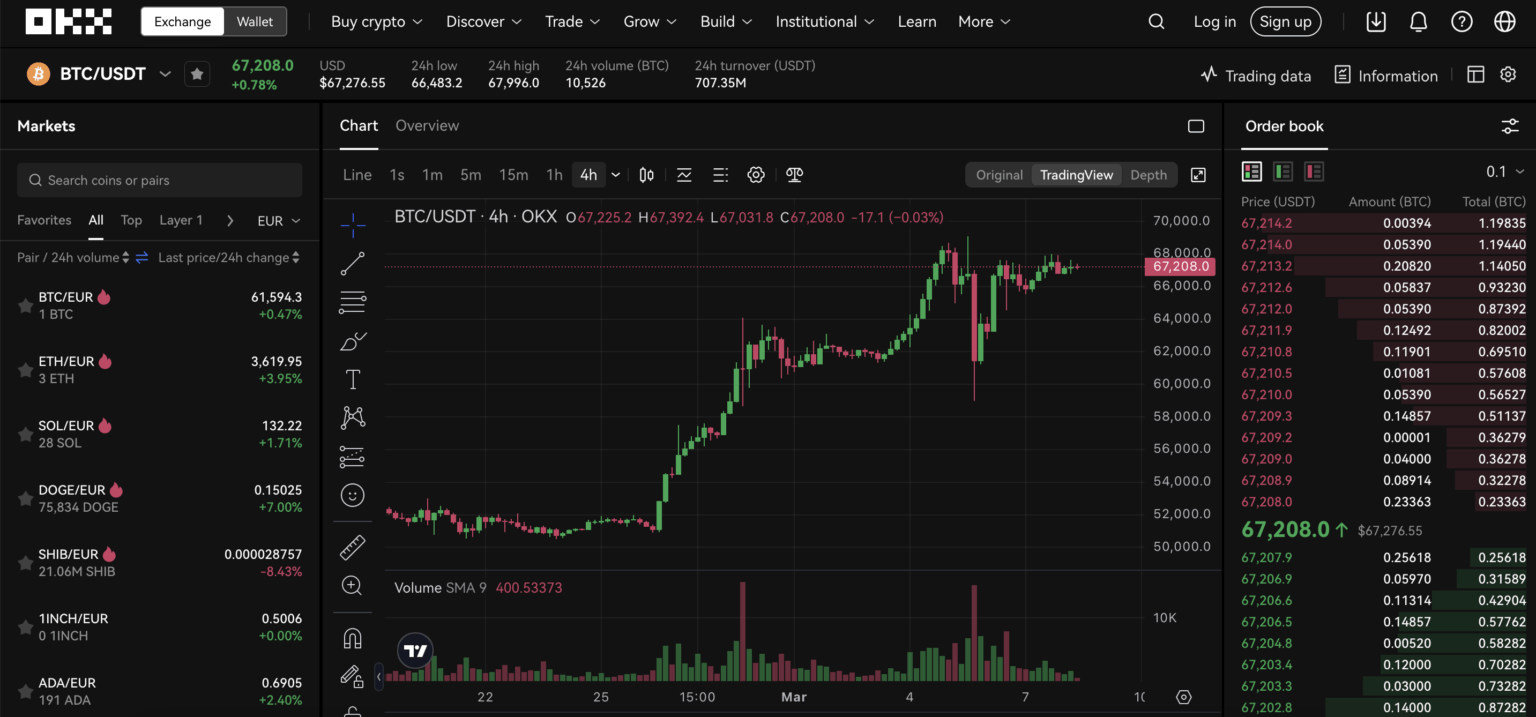
Trading on the spot market is deceptively straightforward. Buy low, sell high—right? Ha. Medium-sentence truth: you still need to understand order types and slippage. Limit orders are your friend for precision; market orders are for speed—and for those moments you accept a little pain (slippage) for execution. Long thought: if you trade high-frequency or during an earnings-style pump, the UI’s refresh rate and order book depth matter, and OKX does a respectable job, though it’s not flawless when liquidity spikes.
Here’s what bugs me about the “quick trade” features on many platforms: they encourage laziness. OKX gives you both quick routes and granular controls. Use the granular controls more than you think. If you’re a scalper, check your order book layers. If you’re a swing trader, focus on limit orders and the trade history to get a feel for market momentum.
On one hand the charts are solid. On the other hand, if you want a fully customizable, plugin-ready charting station you’ll pair OKX with TradingView or another tool. Most traders do. (Oh, and by the way—check your fee tier. Higher volume = lower fees. It’s hardly news, but people forget.)
Managing Your OKX Wallet
Okay, so wallets are a mixed bag across exchanges. I’m not 100% sure about every token’s custody nuances on OKX, and to be honest, that’s something I’d verify before moving large sums. Use small test withdrawals first. Seriously. Something as small as 0.001 BTC can confirm network details and addresses. My rule: test, then transfer.
Now, wallets within OKX are split—spot wallet, funding wallet, etc. Moving funds between them is usually instant, but if you’re bridging chains or withdrawing to an external wallet, network fees and confirmations apply. I once missed a gas fee language quirk and nearly queued a transfer on the wrong chain—double-check chain IDs. Very very important.
Also, consider cold storage for long-term holdings. OKX is secure for trading and short-to-mid-term storage, but I’m old-school enough to keep core holdings offline. That’s subjective, sure, but it’s a preference grounded in risk management.
Security Best Practices (do these)
Quick list—because I know you skim: enable 2FA, set up withdrawal whitelist, use a hardware wallet for large balances, check login activity regularly, and never reuse passwords. My instinct says the most common failures are human errors, not exchange hacks. So reduce human error.
On the policy side, note that KYC policies can be strict depending on your jurisdiction. For US users, comply early—delays happen if documents are unclear. If you’re impatient, you’ll find that rushing verification usually leads to more back-and-forth and annoyance. Trust me, been there.
FAQ — quick answers that save time
How do I log into OKX for the first time?
Sign up with an email, verify it, set a strong password, enable 2FA, and complete KYC if you want fiat or higher limits. Use this link to start: okx.
Can I use OKX in the US?
Yes, but region-specific restrictions and KYC requirements apply. Some products may be limited or unavailable; always check the terms during sign-up.
What’s the difference between spot wallet and funding wallet?
Spot wallet holds assets for trading; funding or fiat wallets handle deposits/withdrawals and sometimes on-ramp/off-ramp functions. Move funds internally for trading, and withdraw from the funding wallet to send assets out.
Is OKX secure?
Generally yes. They use standard industry security like cold storage, multi-sig, and audits, but security is a shared responsibility—protect your 2FA and passwords.
Alright—closing thought. I came in curious and left more cautious but confident. There’s a rhythm to OKX: reliable core functionality, little quirks that reward curiosity, and sensible security defaults if you use them. I’m still learning some edge-case behaviors, and I’ll be honest: their support response times used to annoy me—but things improved. So, try it, test small, and don’t be afraid to ask questions. Something else might come up—and isn’t that the fun part?
